Reading & literacy
How to Help a 3rd Grader Read Better at Home
How to help a 3rd grader read better at home with easy, proven habits for fluency, comprehension, reading aloud and choosing just-right books.
The Professor Poppy team · October 9, 2026 · 8 min read
It's a Tuesday night. Your third grader reads a whole page out loud, nails every word, then looks up blankly when you ask what just happened. Or it's the reverse: they follow the story fine, but they read so slowly that the fun leaks out before the chapter ends.
If you're wondering how to help a 3rd grader read better, you're asking at the perfect moment. You don't need flashcards, workbooks or a teaching degree. What helps most is a few small, steady habits at home that grow the two skills this year is all about: reading smoothly, and understanding what's on the page.
At a glance
- Third grade is the year kids move from learning to read to reading to learn.
- Smooth reading (fluency) and understanding (comprehension) grow together, so practice both.
- Rereading favorite pages, reading aloud together and "why" questions beat drills.
- Let your child choose books, and use a quick one-page check to find a good fit.
Why it matters
Third grade is a turning point. A research guide for parents from the National Institute for Literacy, published with the National Institute of Child Health and Human Development, puts it simply: by the end of third grade, a child must read with ease and understanding to take full advantage of fourth grade and beyond. By then, the guide says, most children read longer stories and chapter books on their own and can summarize the main points of what they read.
The stakes reach further than report cards. A long-term study by the Annie E. Casey Foundation found that about one in six children who aren't reading proficiently by the end of third grade don't graduate from high school on time. Please read that as encouragement, not alarm. It's simply a reason to make reading a warm, everyday part of family life right now.
Here's the hopeful part. The National Reading Panel, a group of experts brought together by Congress to review decades of reading research, found that reading the same text aloud several times, with gentle guidance from a teacher, a classmate or a parent, improves word recognition, fluency and comprehension. In other words, the kitchen-table practice you already do counts.
7 ways to help your 3rd grader read better
1. Turn rereading into a game
Think about how a song gets easier the more you sing it. Reading works the same way. The first time through a page, your child is busy figuring out words. By the third time, their brain is free to notice the jokes, the feelings and the plot. Short, cheerful sessions win: ten relaxed minutes beat forty tense ones every time.
Try this: Pick one fun page, like a poem, a silly joke page or a favorite scene, and have your child read it on Monday, Wednesday and Friday. On Friday, say, "Listen to how smooth that sounds now!"
2. Keep reading aloud to them
Lots of families quietly stop reading aloud once a child can read alone. Keep going if you can. When you read a book that's a little above their level, your child hears what fluent, expressive reading sounds like, picks up new words and ideas, and gets to enjoy a story they couldn't manage solo yet. It's also one of the coziest ten minutes of the day.
Try this: Start a "one chapter a night" bedtime book that's a step harder than what your child reads alone, and always stop at a cliffhanger.
3. Share the reading and show the expression
Kids learn expression by copying it. When you read one page and they read the next, you're quietly showing them how to pause at a period, lift your voice at a question and give the grumpy character a grumpy voice. You don't need to explain any of it. They'll soak it up.
Try this: Play "radio reader." Your child reads a page as if it's going out live on the radio, full of feeling, while you play the delighted audience.
4. Ask questions that need a little detective work
"Did you like it?" usually earns a shrug. Questions that make kids hunt for clues build real understanding. If your child gets stuck, shrink the job: talk about one page instead of the whole chapter, and invite them to flip back and find the answer. Looking back isn't cheating. It's exactly what strong readers do.
Try this: After reading, ask one of these: "Why do you think she did that?", "What clue told you he was nervous?" or "Can you tell me the story in three sentences?"
Professor Poppy's tip: Give your child a reason to read before they start. "Read this page and tell me what the dog is planning" turns a reading job into a mission.
5. Help them find just-right books
A just-right book is one your child can mostly read alone while still bumping into a few new words. Many teachers use a quick five-finger check: read any page and raise one finger for each word you don't know. Zero or one finger means it's an easy, fun read. Two or three fingers is just right. Four fingers means it's worth a try with you nearby. Five or more means it's better as a read-aloud for now.
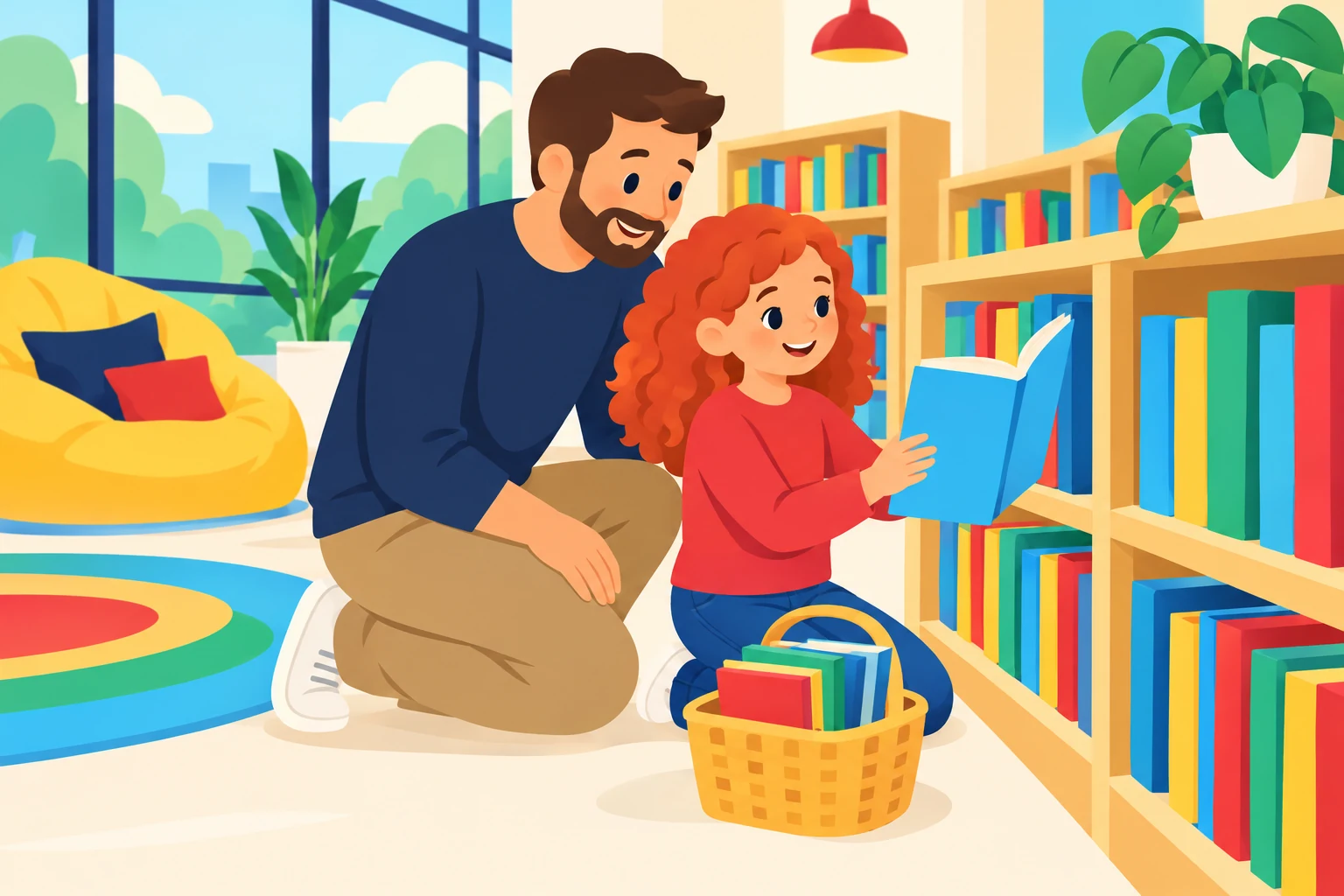
Whenever you can, let your child make the final pick. A book they chose is a book they're much more likely to finish.
Try this: On your next library trip, come home with a mix: one easy "fun read," one just-right book and one harder book you'll share together.
6. Grow their word power
Third graders start meeting words that rarely come up in everyday talk, like "enormous," "reluctant" or "disagree." Third-grade standards in most states expect kids to use clues in the sentence and word parts, like "dis-" or "-ful," to work out what a new word means. Chat about new words when they pop up, and cheer for smart guesses even when they're not quite right.
Try this: When you hit a new word, cover it with your thumb and ask, "What word would make sense here?" Then reveal the real word and compare.
7. Read more than stories
Reading in third grade isn't only stories. It's science books, maps, charts, directions and short articles too. Kids who already read all kinds of text at home walk into class feeling ready for it.
Try this: Hand your child the pancake recipe this weekend, or the map for your next outing, and make them the family's official reader.
Age by age
| Age | What it looks like | How to help |
|---|---|---|
| Starting 3rd grade (about 8) | Reads short chapter books with help, may still sound choppy on new words, retells the main events. | Reread favorite pages, take turns reading, and keep a nightly read-aloud going. |
| Middle of 3rd grade | Reads more smoothly, starts reading nonfiction for facts, uses picture and sentence clues for new words. | Ask "why" and "how" questions, and bring in recipes, maps and fact books. |
| End of 3rd grade (about 9) | Reads chapter books alone, summarizes what happened, reads fiction, nonfiction and poetry. | Let them choose, talk about books like a book club, and stretch with a harder shared read. |
Try it tonight: the Story Detective bookmark
Time: about 15 minutes. You'll need: an index card or a strip of paper, crayons or markers, and any book your child is reading.
- Fold the card in half. Your child draws a magnifying glass on the front.
- Inside, write four question starters: Who is the story about? Where does it happen? What is the problem? Why did it turn out that way?
- Your child reads for 10 minutes, then picks one question from the bookmark and answers it out loud.
- Next week, add a tougher one: "What lesson did the character learn?"
For more practice that feels like play, try our free reading games and the printable activities on our bonus downloads page.
Professor Poppy's tip: Celebrate effort, not perfection. A child who feels like a reader keeps reading, and that's how every skill grows.
Books that help
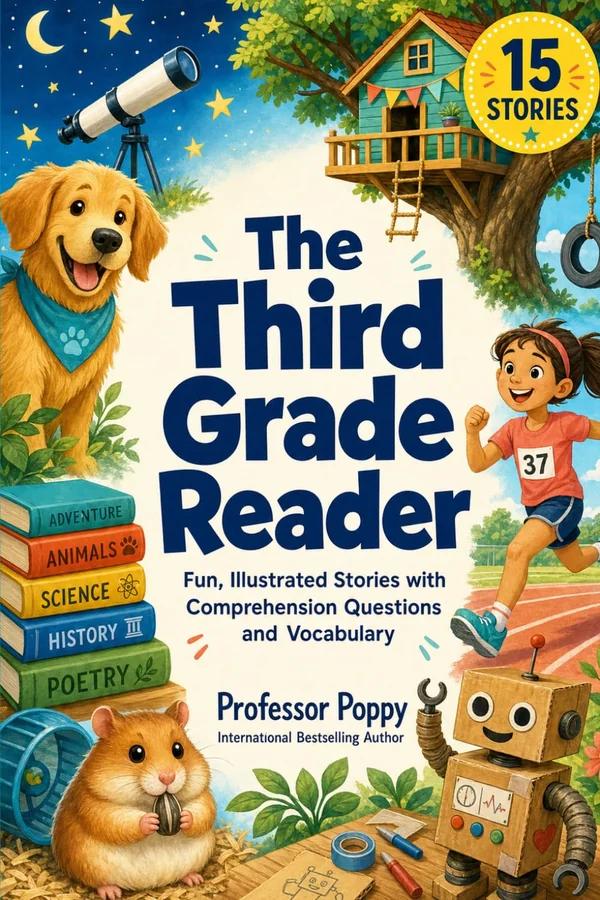
- The Third Grade Reader has short, illustrated stories sized just right for third graders, each followed by comprehension questions and vocabulary words, so the "think about it" chat is already built in.
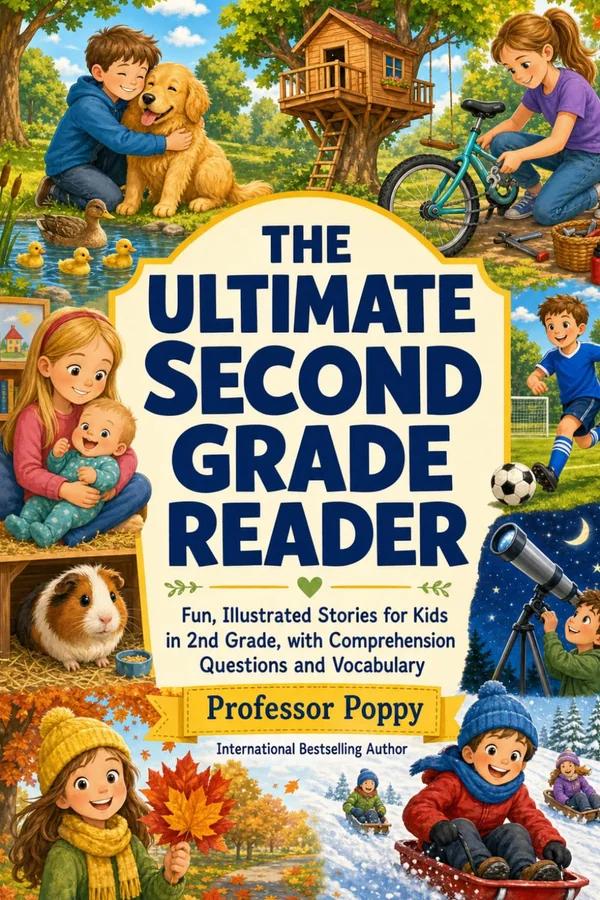
- The Ultimate Second Grade Reader offers slightly easier stories in the same format, perfect for building confidence and fluency through rereading.
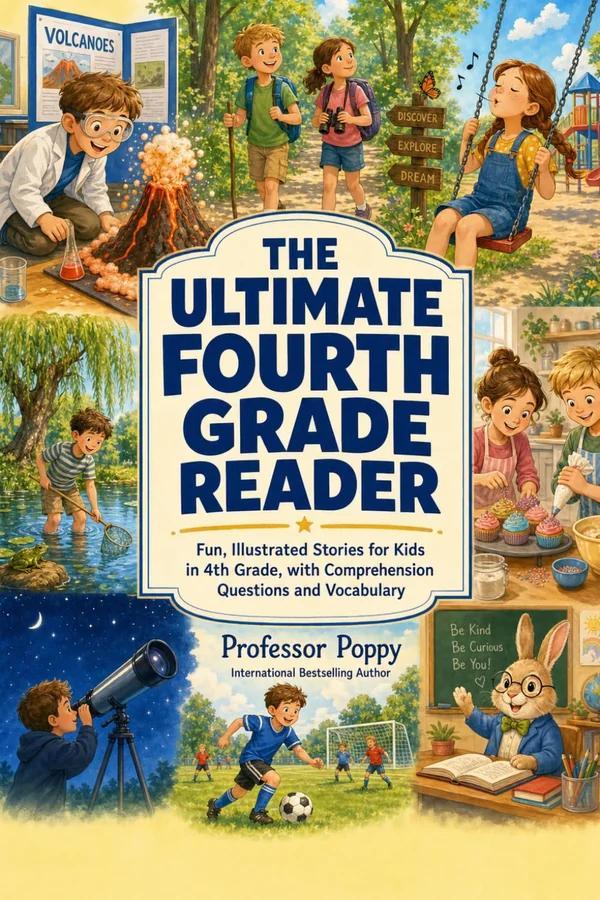
- The Ultimate Fourth Grade Reader is a natural next step for strong third graders ready to stretch.
Quick answers
Should a 3rd grader be reading chapter books?
Most are getting there. By the end of third grade, children typically read longer stories and chapter books on their own. If your child isn't there yet, keep reading chapter books aloud together while they practice with shorter texts they can handle.
Is it OK to keep reading aloud to my 8-year-old?
Absolutely. Hearing you read a book above their level shows them what fluent, expressive reading sounds like and lets them enjoy stories they can't yet read alone. It also keeps reading feeling like a treat instead of homework.
How do I know if my 3rd grader is struggling with reading?
Watch for very slow or choppy reading, lots of guessing at words, or trouble retelling what they just read. If you notice these signs for several weeks, talk with your child's teacher. They can look for specific challenges and suggest next steps, and the sooner you ask, the easier it is to help.
Sources
- National Institute for Literacy and National Institute of Child Health and Human Development: A Child Becomes a Reader, Kindergarten Through Grade 3
- National Institute of Child Health and Human Development: Report of the National Reading Panel
- Annie E. Casey Foundation: Double Jeopardy, How Third-Grade Reading Skills and Poverty Influence High School Graduation