Learning at home
How to Answer Kids' Why Questions (Without Running Dry)
How to answer kids' why questions with less stress and more fun. Wonder together, look it up together and turn big questions into mini experiments.
The Professor Poppy team · October 9, 2026 · 7 min read
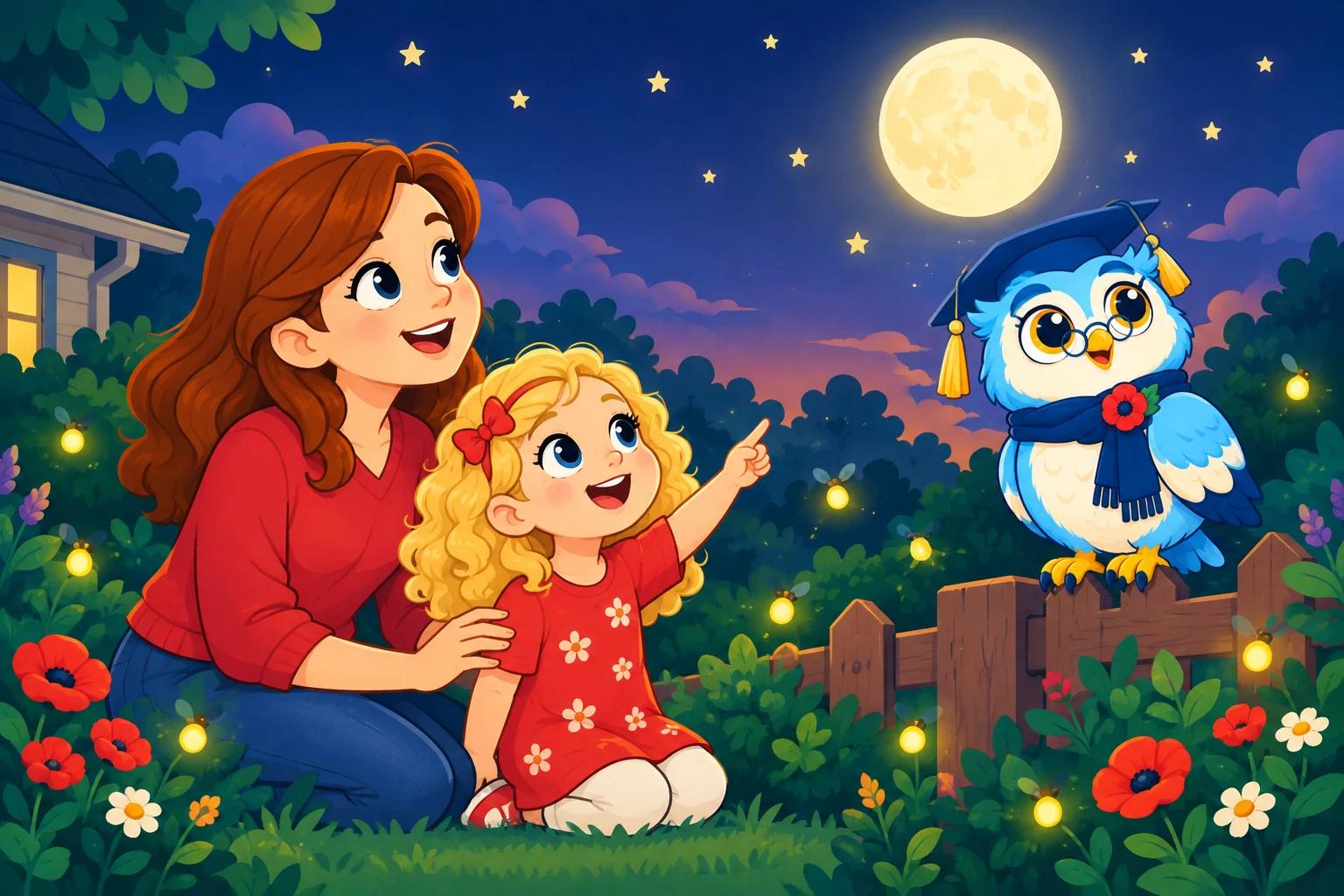
You're halfway through the dishes when it starts. "Why is the moon following our car?" Then, before you've found an answer: "Why is it round? Why can we see it in the daytime? Why?" By the fourth why, you're tempted to say "Because it just is."
We've all been there. The good news is that you don't need to know everything to be great at this. Learning how to answer kids' why questions is less about having the perfect fact ready and more about what you do next. This guide shows you how to turn the endless whys into some of the best learning moments of your day, with ideas for every age.
At a glance
- Young children ask a huge number of questions, and each one is a chance to build their brain and their bond with you.
- "I don't know, let's find out" is one of the best answers you can give.
- Real explanations satisfy kids. Brush-off answers usually lead to more whys.
- Many questions can become tiny experiments at the kitchen table.
Why it matters
Curious questions are how young children make sense of the world, and they ask a lot of them. In a well-known study published by the Society for Research in Child Development, children between ages 1 and 5 asked an average of about 76 information-seeking questions per hour while talking with adults. That's more than one a minute.
Those questions pay off later. Researchers at the University of Michigan looked at a large national sample of about 6,200 young children and found that curiosity, especially an eagerness to learn new things, predicted reading and math scores in kindergarten about as well as self-control did. The link was strongest for children from lower-income families.
How you respond matters too. The Center on the Developing Child at Harvard University describes "serve and return" moments, when a child reaches out and an adult responds with interest, as one of the main ways healthy brain connections are built. A why question is a serve. Your answer is the return.
How to answer kids' why questions: 6 ways that work
1. Answer the question with a real reason
Kids can tell the difference between an answer and a brush-off. Researchers at the University of Michigan found that when preschoolers got a real explanation, they were more likely to be satisfied or ask a thoughtful follow-up. When they got a non-answer, they were more likely to repeat the question or come up with their own explanation. So keep it short, but make it real: "The moon looks like it's following us because it's very, very far away. Close things zip past the window, but far things seem to stay put."
Try this: Give the simplest true reason in one or two sentences, then stop and see if your child wants more.
2. Ask what they think first
Before you answer, toss the question back with a smile: "Hmm, what do you think?" You'll learn what your child already knows and what puzzles them, and you'll hear some wonderful theories. Thinking out loud is a skill, and it grows every time they try.
Try this: Say, "That's a great question. What's your best guess?" and listen to the whole answer before you add yours.
3. Wonder together
You don't have to be the expert. When you say "I've always wondered that too," you show your child that curiosity doesn't end when you grow up. It also takes the pressure off you on the days your brain is tired.
Try this: Keep a "Wonder List" on the fridge. When a question comes up at a busy moment, write it down together and promise to come back to it.
4. Look it up together
"I don't know, let's find out" may be the most powerful sentence in parenting. Pull a book off the shelf, ask a librarian, or call a grandparent who knows about gardens or engines. Your child sees how grown-ups find answers and learns that knowledge lives in many places.
Try this: Once a week, take one question from your Wonder List and track down the answer together in a book.
5. Turn the question into a mini experiment
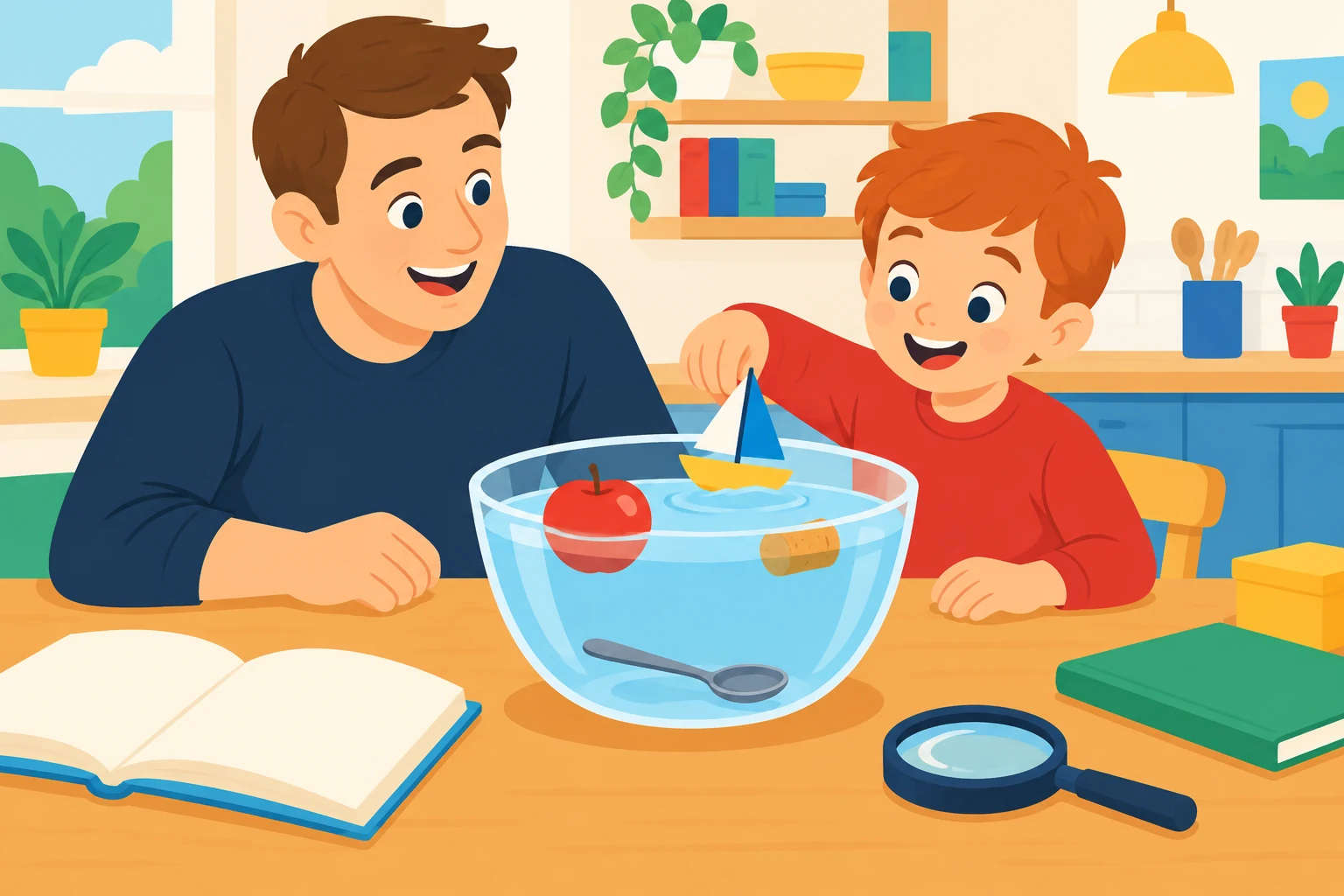
Some of the best answers come from trying things. "Why do some things float?" becomes a bowl of water and a pile of household objects. "Why do plants need sun?" becomes two bean seeds, one on a sunny windowsill and one in a dark cupboard. Kids remember what they discover with their own hands.
Try this: Ask your child to make a guess before every test. Being wrong is part of the fun, and it's exactly how scientists work.
6. Know when to pause
Sometimes the whys are about connection, not information, especially at bedtime. It's fine to say, "That's such a good question. Let's save it for breakfast." A calm, honest pause keeps curiosity alive far better than a frustrated answer.
Try this: At bedtime, let your child choose one last question, then tuck it onto the Wonder List for the morning.
Professor Poppy's tip: Your tone matters as much as your answer. A smile and "Ooh, good one!" tells your child that wondering is welcome here, even when the answer has to wait.
Age by age
Every child develops at their own pace, so use this as a friendly guide, not a checklist.
| Age | What it looks like | How to help |
|---|---|---|
| 2 to 3 | Lots of "What's that?" and early "Why?" questions, sometimes the same one again and again. | Name things, keep answers to one short sentence, and point and show whenever you can. Repeating the question is how they practice. |
| 4 to 5 | The peak of the why stage. Questions about bodies, animals, weather, death and where things come from. | Give simple true reasons, ask "What do you think?", and try quick hands-on tests like sink or float. |
| 6 to 8 | Deeper "how" and "what if" questions. Kids start noticing when an answer doesn't add up. | Look things up together in books, start a Wonder List, and let them test their own ideas. |
| 9 to 12 | Big questions about space, history, fairness and how things work. | Help them find answers on their own, then ask them to teach you what they learned. |
Try it tonight: the Sink or Float Challenge
Time: about 15 minutes. You'll need: a large bowl or sink of water, a towel, and six to eight safe household objects (an apple, a spoon, a cork, a crayon, a coin, a toy boat, a leaf).
- Lay the objects out and ask, "Which ones will float? Why do you think so?"
- Sort them into two piles: "float" guesses and "sink" guesses.
- Test each object, one at a time. Cheer for every surprise.
- Talk about what you noticed. Heavy-feeling things don't always sink, and light ones don't always float. An apple floats because it has lots of air inside it.
Young children should always have a grown-up with them around water. Afterward, add any new whys to your Wonder List. If your family loves this kind of play, our games page has more ways to learn while having fun.
Professor Poppy's tip: The best answer to "Why?" is sometimes "Let's find out!" When you discover something together, your child learns the answer and learns how to learn.
Books that help
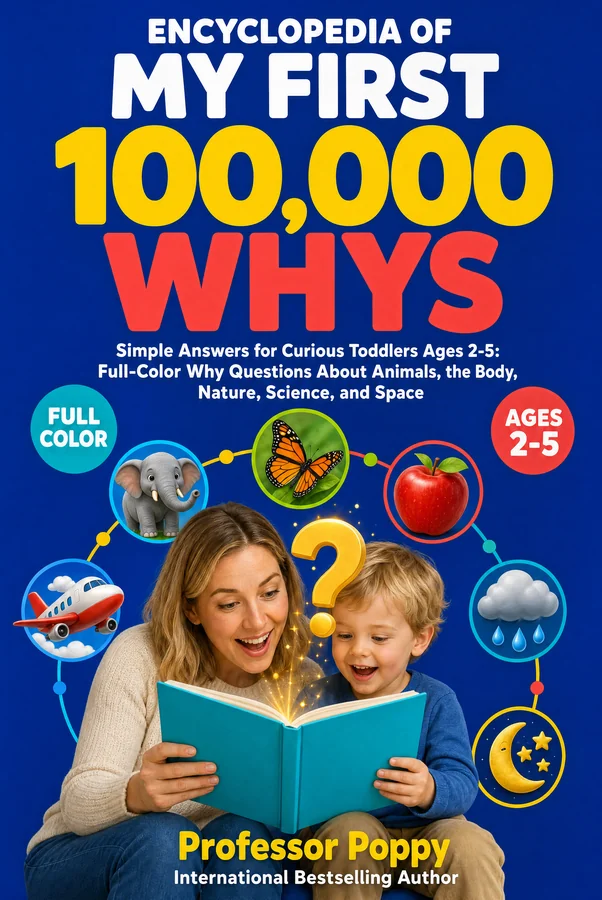
- My First 100,000 Whys answers the questions little ones ask most, in short, friendly explanations that are perfect for reading together.
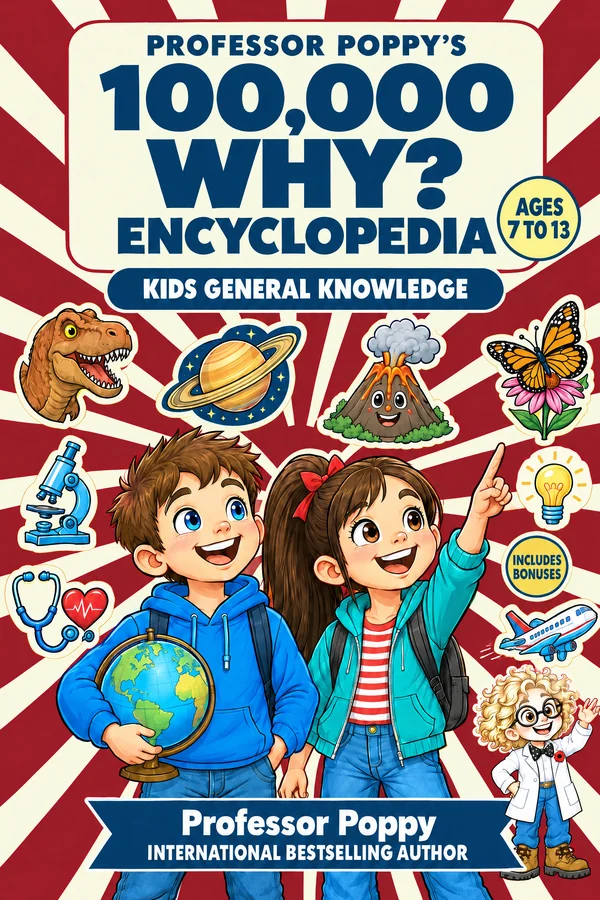
- Professor Poppy's Fully Illustrated 100,000 WHY Encyclopedia is a colorful, fully illustrated go-to for older curious kids who want to dig into science, nature and how the world works.
Looking for more ways to keep curious minds busy? Try our screen-free family game night ideas, which include question games kids love.
Quick answers
Why does my child ask "why" all the time?
Asking why is how young children make sense of the world. The why stage often peaks around ages 3 to 5, when language is taking off and kids are trying to understand cause and effect. It's a healthy sign of a curious, developing mind.
What should I say when I don't know the answer?
Be honest: "I don't know, but let's find out together." Then look it up in a book or ask someone who knows. Showing your child how to find an answer is just as valuable as knowing it.
Is it okay to tell my child I need a break from questions?
Yes. Everyone gets tired. Say it kindly, such as "That's a great question, let's save it for after dinner," and then remember to come back to it. Keeping your promise teaches your child that their questions matter.
Sources
- Society for Research in Child Development: Chouinard, M. M., Children's Questions: A Mechanism for Cognitive Development (2007)
- University of Michigan: Shah, P. E. and colleagues, Early Childhood Curiosity and Kindergarten Reading and Math Academic Achievement, Pediatric Research (2018)
- University of Michigan: Frazier, B. N., Gelman, S. A. and Wellman, H. M., Preschoolers' Search for Explanatory Information Within Adult-Child Conversation, Child Development (2009)
- Center on the Developing Child at Harvard University: Serve and Return